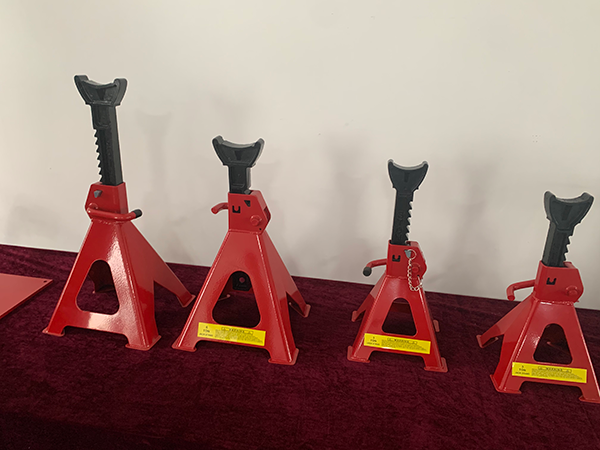
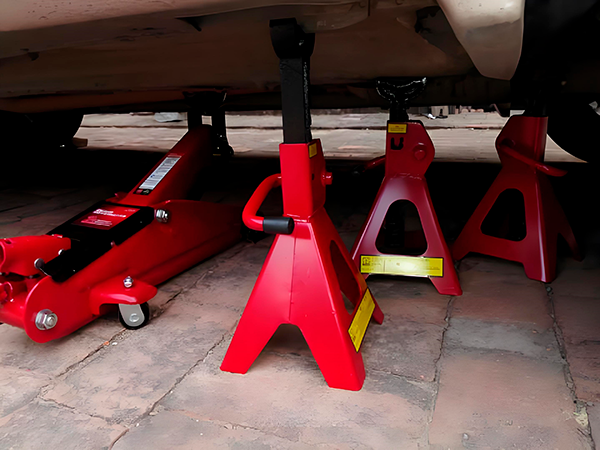
Car jack stands are an essential safety tool in car repair and maintenance, used to safely support a vehicle after it has been raised off the ground. They are not lifting devices in themselves; instead, they provide a stable, sturdy platform that can support the weight of the vehicle while you work underneath it.
Here's a breakdown of what they are and why they're crucial:
1. Function: Safety Support
After raising the vehicle with a jack (floor jack, scissor jack, bottle jack, etc.), they hold it securely in the raised position.
Key Safety Function: They prevent the vehicle from collapsing on you if the lift jack fails, leaks, or shifts out of position. Never work under a vehicle that is supported only by a jack.
2.Design & Construction
Structure: Usually made of heavy steel (plain) or lightweight aluminum alloy. They include
- Base: A wide, stable platform (usually tripod or square) that contacts the ground.
- Vertical Column/Upright: Provides height.
- Ratchet or Pinhole: Adjusts height settings.
- Saddle/U-Head: The top piece that contacts the designated lifting point of the vehicle (usually a reinforced area on the frame, subframe, or a dedicated jacking rail). The saddle is usually V-shaped or U-shaped to firmly hold the lifting point and prevent sliding.
Height Adjustment: Most stands have multiple height settings that are adjusted by ratcheting the pawl lever or inserting the locking pin into the aligned holes on the upright.
Weight Capacity: The stand is clearly marked (e.g. 2 tons, 3 tons, 6 tons). Importantly, this rating is usually calculated per stand. You need to choose a single stand with a weight capacity that exceeds the weight of the heaviest corner of the vehicle. Be sure to buy a stand rated higher than the gross weight of your vehicle (e.g., a 3-ton stand for a 2-ton car).
Safety features: Look for features like dual locking mechanisms (such as ratchet pawls and secondary locking pins), a wide base for stability, and reinforced welds. Reputable brands meet safety standards (such as ANSI standards in the United States).
3.How to Use
- Lift: Jack up the vehicle from the designated jacking point using a hydraulic jack (such as a floor jack).
- Position: Slide the jack stand under the vehicle's designated support point (usually close to the jacking point, but specifically designed to bear weight for a long time). Make sure the saddle is properly positioned under the support point.
- Lower and Secure: Slowly lower the vehicle using the jack until its weight rests firmly on the jack stand. The jack can usually be left in place as a secondary support, but the primary support must be the stand.
- Work: Only once the vehicle is securely supported on the stands, position yourself under the vehicle to perform the work.
- Repeat: For most work (such as oil changes, brake work, suspension work), you will need to use multiple stands to support both ends of the axle or all four corners of the vehicle.
4.Key Differences from Car Jacks
| Feature | Jack Stands | Jacks (Hydraulic/Scissor) |
| Primary Function | Support weight securely | Lift the vehicle |
| Safety Under Load | Designed for long-term stability | NOT safe for long-term support |
| Mechanism | Rigid, locking support | Hydraulic cylinder or screw mechanism |
| Reliability | High (when used correctly) | Can fail unexpectedly |
| Use Under Car | Safe once vehicle is lowered onto them | Extremely Dangerous |
5.Common Uses:
- Oil changes
- Brake pad/rotor replacement
- Suspension work (shocks, struts, control arms)
- Transmission work
- Exhaust work
- Tire rotation (when paired with a jack)
- Any task requiring access underneath the vehicle
A car jack stand is a strong, stable, reliable support that holds the lifted vehicle securely in place while you work underneath it. Using them correctly is essential to safely perform car repair work.
Always choose a stand with adequate weight rating, inspect the stand for damage before use, properly position it on solid, flat ground at the manufacturer's designated support points, and never rely solely on the jack to support the vehicle.